
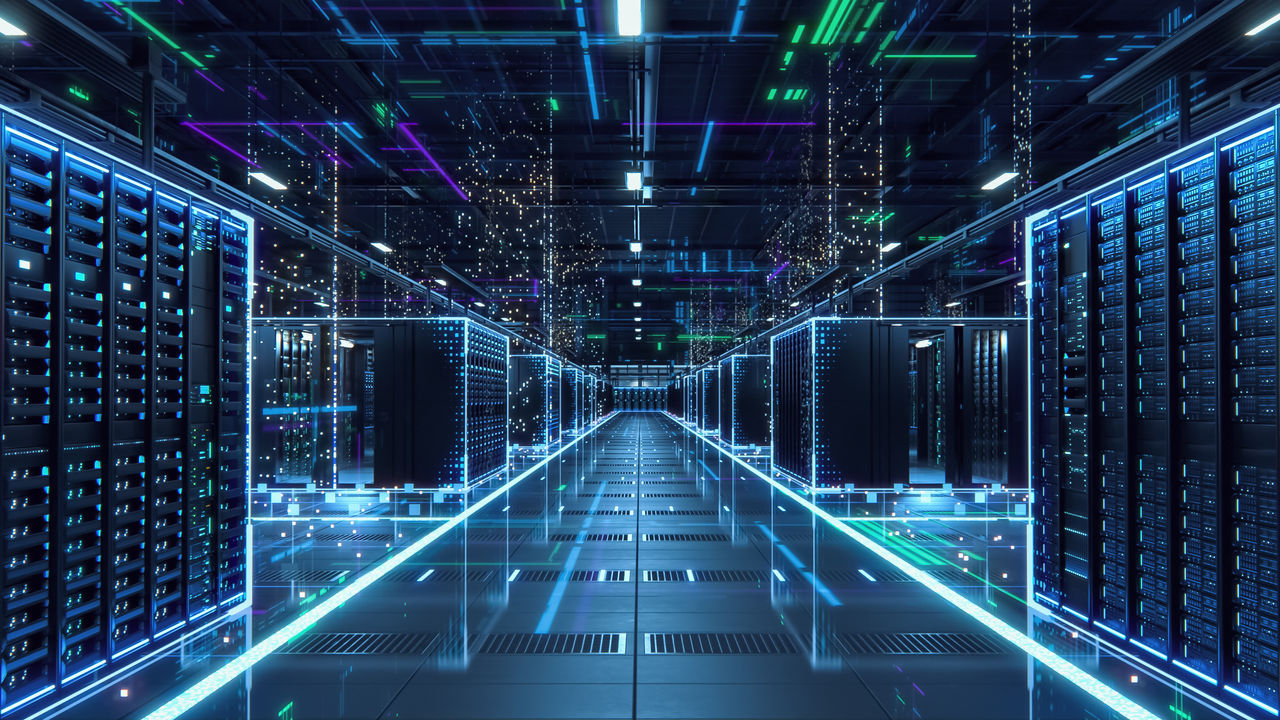
Setting up an AI data center requires careful planning and a deep understanding of the hardware and system requirements. Read on to gain a basic knowledge of the essential AI data center hardware you need to scale with the demands of modern AI technology.
Components of AI Data Center Hardware
An AI data center is not the same as a traditional data center. The purpose is different: It is designed to execute AI algorithms.
Key hardware components include high-performance graphic processing units (GPUs), powerful central processing units (CPUs), memory modules, and storage systems. All these work together to support AI and machine-learning tasks.
How AI Data Center Hardware Is Different
Traditional data centers provide a variety of general-purpose services (e.g., web hosting, database management). Their equipment reflects this, leaning towards routine data processors and storage.
AI data centers, meanwhile, are built specifically for high-performance computing. Their equipment must be able to handle intensive processing.
One major difference is the way they include AI-specific components (e.g., GPUs and tensor processing units or TPUs) because they need them to perform parallel tasks at a far greater speed than standard CPUs can deliver. Additionally, AI data centers often require large-scale storage solutions and high-bandwidth networking to keep up with the massive amounts of data they may have to process in real-time.
All that computation means significant heat, too, so the center’s power and cooling systems must also be tailored to handle the intense energy demands of AI applications.
The Role of GPUs in AI Data Center Infrastructure
The GPU (which is at the heart of an AI graphics card or integrated into a motherboard or CPU is responsible for accelerating machine learning tasks by performing many calculations simultaneously. Unlike CPUs (optimized for sequential processing), GPUs are designed to handle parallel workloads; this makes them ideal for AI training, inference, and other similar tasks.
Companies like NVIDIA and AMD are the leading providers of GPUs made for AI. Such GPUs offer exceptional memory bandwidth and computational power, allowing AI data centers to efficiently process huge amounts of data to accelerate deep-learning model training or enable real-time AI applications (e.g., image recognition, natural language processing, computer vision, etc.).
Managing Power Consumption in AI Data Centers
Power management is vital. As you know, AI workloads consume significant energy.
One such strategy is using liquid cooling systems. They are more efficient than air cooling at heat dissipation.
AI data centers also often rely on energy-efficient hardware. Using (relatively) low-power GPUs and processors can minimize energy consumption and environmental impact.
Specialized Storage Solutions
The large datasets AI models process during training, during inference, or at any other stage of AI processing mean AI data centers must have high-capacity and low-latency storage.
Traditional storage systems are unlikely to be fast enough to keep up with the high throughput required by AI tasks. As such, AI data centers may deploy non-volatile memory express (NVMe), SSDs, or high-capacity hard drives in various combinations and configurations. They can ensure rapid data access. Using distributed storage systems (which spread data across multiple devices) is another common strategy; it’s especially apt for setups where scalability is critical.
Redundancy is another consideration. There is a need to ensure data is protected and available even if a part (or parts) of the system fails.
FAQs
Here are answers to some of the most frequently asked questions about AI data center hardware:
1. Why use specialized hardware for AI workloads?
Specialized hardware such as GPUs and AI accelerators dramatically improves the performance of machine learning tasks by providing the parallel processing capabilities needed for efficient training. This reduces model training times and enables faster deployment of AI applications.
2. What is the best GPU for AI data centers this 2025?
It depends on your specific AI application. NVIDIA RTX PRO 4500 Blackwell GPU and NVIDIA RTX A4500 Graphics Card are top choices and can provide outstanding performance. You can also get AI servers, which should include a GPU optimized for AI.
3. How do AI chips like TPUs impact AI data center performance?
Tensor Processing Units (TPUs) are custom-built chips that specialize in accelerating machine learning workloads. They facilitate offloading specific AI tasks from the CPU and GPU.
4. What are the security measures specific to AI data centers?
Strategies or security measures used by AI data centers include encryption, secure access controls, and firewalls. Hardware-level security features like Trusted Platform Modules (TPMs) are also used to ensure the integrity and security of AI hardware.
5. How does quantum computing affect the future of AI data centers?
Quantum computing, while still in its early stages, could provide the massive growth push the AI industry needs, as it could drastically reduce the time needed to train AI models.
Build an AI Data Center
An AI data center uses specialized equipment. Specifically, it integrates powerful GPUs, specialized storage, and efficient power management, perfectly orchestrated to support AI workloads.