
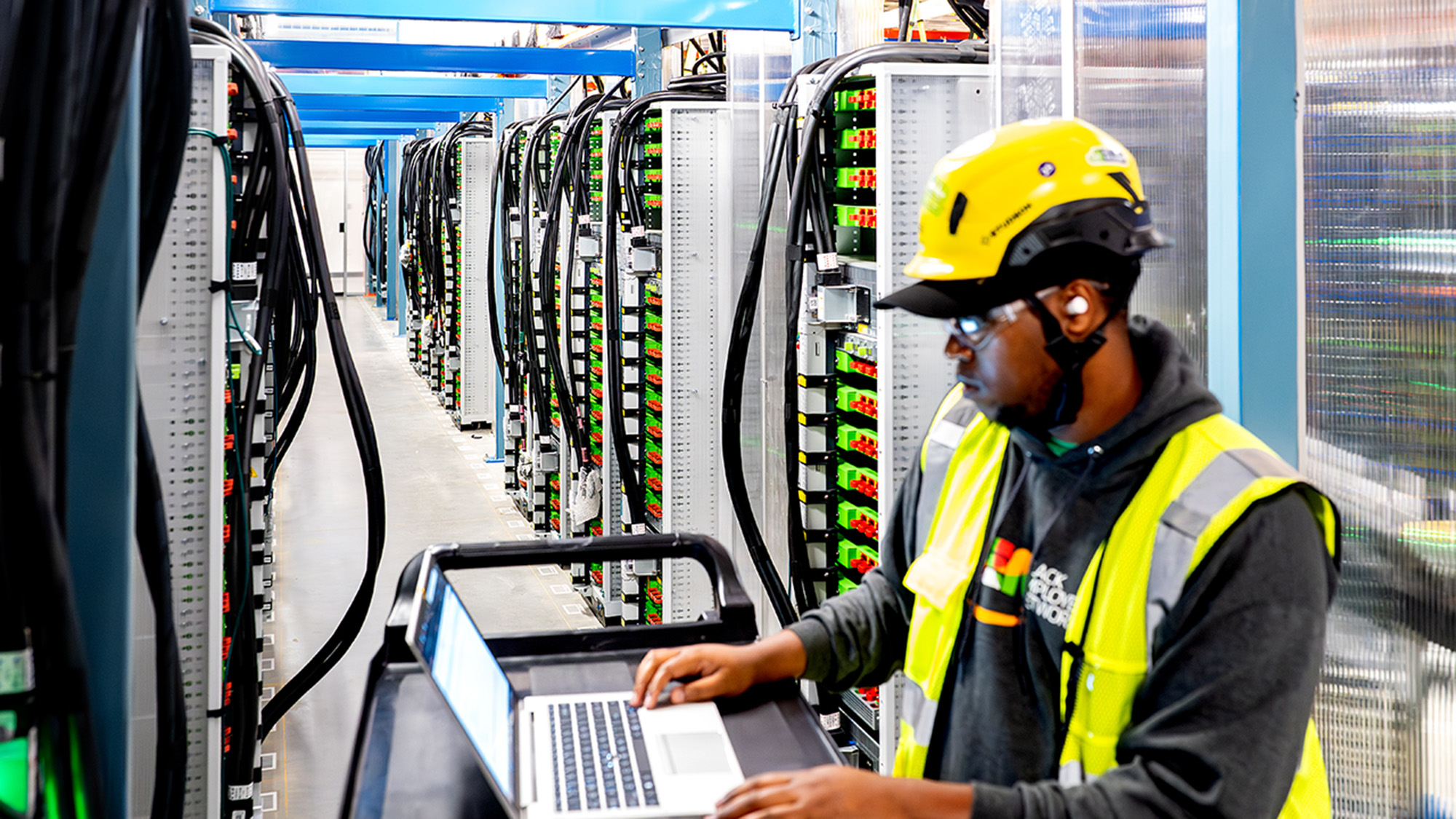
Data is at the heart of nearly everything. Businesses process volumes of information per millisecond in what has now become one of the most valuable pieces of real estate development: data centers. Today’s (and tomorrow’s) data centers are unlike the structures you’ve come to know because they’re engineered to support artificial intelligence (AI), complex workloads, and analytics.
The need for AI servers is no longer just an edge but a growing necessity for businesses like yours. The shift, however, isn’t just about aligning IT infrastructure with results. It’s also about balancing costs alongside future-proofing a data strategy.
What does the future look like for data centers? And how can your business ensure its investments today will continue to deliver value tomorrow?
We take a look at where the industry is headed and what strategies you can apply to keep pace.
At the Core of Tomorrow’s Data Centers
Although CPUs remain critical, they simply cannot keep up with the exponential demand for parallel processing in AI and machine learning workloads. But AI servers, powered by enterprise GPUs, can meet this demand.
These servers are purpose-built to accelerate training and inference tasks, making them the new workhorses of the modern data center.
For businesses, this translates into:
- Faster insights – AI servers reduce the time it takes to train complex models from weeks to days, or even hours.
- Improved customer experiences – From real-time fraud detection in finance to AI-driven personalization in retail, companies can deliver smarter services.
- Operational efficiency – Workloads like predictive maintenance in manufacturing or medical image analysis in healthcare can be processed at scale, without bottlenecks.
Investing in AI-powered data centers is no longer a question of “if” but “when.” Businesses today are deploying mini data centers closer to where data is generated, at factories, retail stores, hospitals, or even smart cities. Why is this important? Because speed matters.
AI-driven applications like autonomous vehicles, telemedicine, and IoT-enabled manufacturing cannot afford the latency of sending data back and forth to a central data center. Edge computing solves this by processing information locally, enabling real-time decision-making.
For enterprises, edge computing powered by AI data center hardware means:
- Reduced latency – essential in industries, such as health care and logistics, where milliseconds matter a great deal.
- Bandwidth optimization – to prevent overloading networks with raw data
- Enhanced reliability – to ensure no disruption.
Building Sustainable Data Centers
The rise of AI servers and GPU-heavy infrastructure is increasing power and cooling demands immensely. According to a Bloomberg analysis, the energy consumption of data centers is straining current electricity grids. Meanwhile, a report from Deloitte sees electricity usage from data centers doubling to 1,065 terawatt-hours (TWh) by 2030 (from 536 TWh in 2025.
The race to build bigger and better data centers is affecting the reliability and quality of power in communities where these facilities are located.
Land use is another concern since data centers occupy enormous space at the expense of retail and residential development. Although governments across the globe are implementing regulatory initiatives to curb the environmental impact of data centers, businesses must also do their part to manage resources.
For enterprises, sustainability is not just a corporate responsibility — it’s a long-term business strategy. For example, Big Tech companies are relying on alternative energy sources to build their data centers.
Future-proofing your AI data center hardware means thinking beyond performance and considering environmental impact.
Leading innovations to consider include:
- Liquid cooling and advanced HVAC systems that minimize wasted energy.
- Partnering with providers that power data centers through solar, wind, or hydroelectric sources.
- Using AI itself to monitor and optimize workloads, ensuring servers are running efficiently.
Key Technologies to Invest in Now
Businesses need to adapt smoothly to the technology of tomorrow. The key piece of strategy to apply is flexibility. Data centers, for one, need to be upgraded piece by piece rather than with full replacements. Another critical strategy is choosing vendors and systems that allow your organization to be agile.
Businesses that want to stay competitive need to consider flexibility, scalability, and integration. For many, this means integrating emerging technologies into a cohesive strategy.
The following technologies are worth investing in:
- Security-first infrastructure
- Hybrid and multi-cloud integration
- High-bandwidth networking
- Next-gen storage solutions
- AI-driven management tools
You can expect significant enhancements in data center AI architecture as NVIDIA, Microsoft, Google, and Intel achieve breakthroughs in processing power, connectivity, and integrated solutions.
NVIDIA’s Blackwell GPU architecture supports trillion-parameter-scale AI models, improving efficiency and scalability. Google continues to advance its Tensor Processing Units for AI workloads and Arm-based Axion CPUs for cloud computing, enhancing the performance and efficiency of Google’s AI and cloud services.
A Future Built on Agility and Intelligence
The future of data centers is dynamic, distributed, and intelligent. In other words, the data center of tomorrow isn’t just about managing data. It’s about unlocking business potential.